
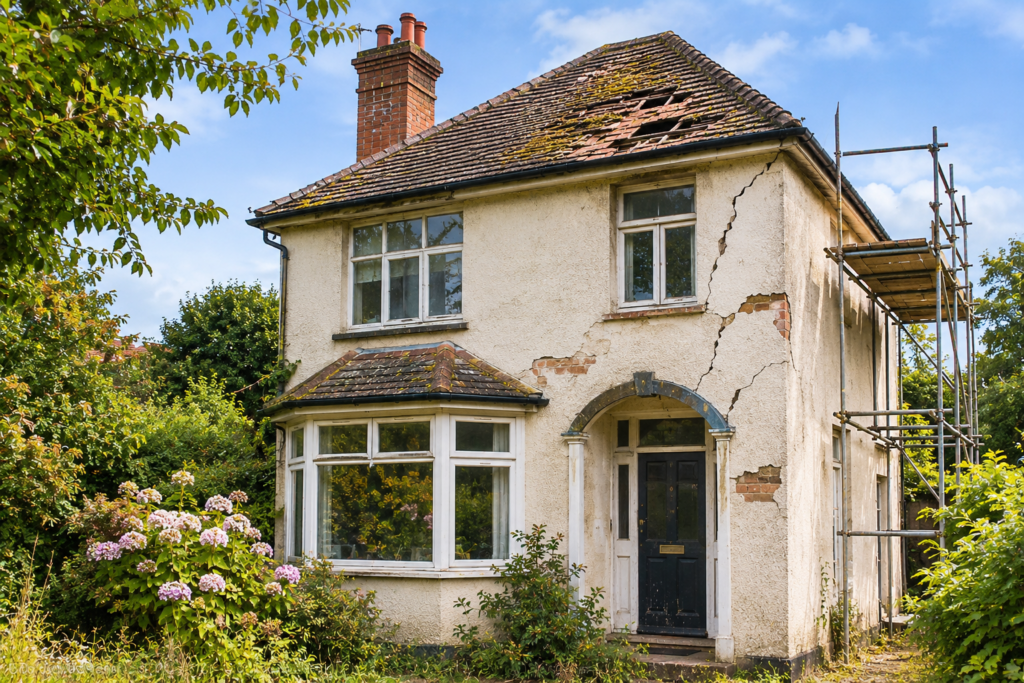
Bridging Finance for Properties With Structural Problems
Found a property with subsidence, structural cracks or a damaged roof? A conventional mortgage may be difficult to arrange, but that doesn’t necessarily mean the property is impossible to finance.
Properties with structural problems can present opportunities for investors, developers and buyers prepared to undertake the necessary repairs. However, securing finance can be challenging, particularly where a mortgage lender considers the property unsuitable security.
This is where bridging finance may offer an alternative.
A bridging loan is a short-term funding solution that can sometimes be used to purchase or refinance properties requiring significant structural repairs, provided the lender is satisfied with the security, proposed works and repayment strategy.
At GPS Financial, we help borrowers explore specialist property finance options for properties that may fall outside conventional mortgage lending criteria.
In this guide, we’ll explain which structural problems bridging lenders may consider, how the application process works and what to consider before purchasing a property with serious defects.
Can You Get Bridging Finance on a Property With Structural Problems?
Yes, potentially. Some specialist bridging lenders will consider properties with structural defects that conventional mortgage lenders may decline.
However, approval is not guaranteed.
The lender will want to understand the nature and severity of the problems, the property’s current value, the proposed repair works and how the loan will be repaid.
For example, a property with historic subsidence that has been professionally repaired may be viewed differently from one experiencing ongoing structural movement.
Likewise, a house requiring roof repairs may be more straightforward to finance than a property with significant foundation failure.
Specialist lenders may consider:
-
Properties with historic or active subsidence.
-
Houses with structural cracking.
-
Properties requiring roof replacement.
-
Buildings with damaged foundations.
-
Properties with structural movement.
-
Houses requiring underpinning.
-
Properties with significant damp or timber deterioration affecting structural elements.
-
Buildings requiring extensive structural refurbishment.
Each application is assessed individually.
If you’re considering a property that a conventional mortgage lender has rejected, our article Can You Get a Bridging Loan on an Unmortgageable Property? explains how specialist finance may help.
Why Do Mortgage Lenders Reject Properties With Structural Problems?
Traditional mortgage lenders generally want properties that are readily saleable, insurable and suitable as security for long-term borrowing.
Structural problems can affect all three.
A surveyor may identify defects that make the property difficult to value or raise concerns about its future condition.
In some circumstances, a mortgage lender may decline the application altogether. Others may require repairs, further investigations or specialist reports before proceeding.
Common issues include:
Subsidence and foundation movement
Subsidence occurs when the ground beneath a property moves downwards, potentially causing the foundations to shift.
This can result in cracking, distortion and other structural damage.
Lenders may require evidence of the cause, whether movement is ongoing and what remedial work is necessary.
Significant structural cracking
Not every crack indicates a serious structural problem.
Minor settlement cracks and superficial plaster damage are common in older properties.
However, substantial diagonal cracking, stepped cracks in brickwork or cracks that continue to widen may require investigation by a structural engineer.
The underlying cause matters far more than the appearance of the crack itself.
Damaged or deteriorating roofs
A roof with missing tiles isn’t necessarily a structural problem.
However, failing roof timbers, significant sagging or widespread deterioration can affect the building’s structural integrity.
Where the roof requires major reconstruction, conventional mortgage funding may be difficult to obtain.
Foundation defects
Properties with inadequate, damaged or unstable foundations can present substantial risks.
Remedial work may involve underpinning, ground stabilisation or other specialist engineering solutions.
These projects require careful assessment because repair costs can be significant.
Structural alterations without adequate documentation
A property may have undergone major alterations, such as removing load-bearing walls or constructing extensions.
Where appropriate building control documentation or structural evidence is missing, lenders may request further investigations.
The absence of paperwork doesn’t automatically mean a property is structurally unsound, but it can complicate financing.
How Does Bridging Finance Work for a Structurally Damaged Property?
Bridging finance is designed to provide short-term funding where there is a clear and credible repayment strategy.
Unlike a conventional mortgage, which is generally intended for longer-term borrowing, a bridging loan may be used to finance a property while structural repairs are completed.
The process typically involves several stages.
1. Assessing the property
The lender will need information about the property’s current condition.
This might include photographs, survey findings, a structural engineer’s report or details of previous repairs.
For more serious defects, specialist reports may be essential.
2. Establishing the repair costs
A lender may want to understand the proposed works and their estimated cost.
For substantial structural repairs, this could involve detailed quotations from contractors or a schedule of works.
3. Reviewing the security
The lender will assess the property being financed and any additional security offered.
The property’s current condition can affect its valuation and the amount available to borrow.
Some lenders may also consider the anticipated value following completion of the repairs, although lending against future value is subject to specific criteria.
4. Agreeing the repayment strategy
Before approving a bridging loan, the lender will want to understand how the borrowing will be repaid.
For example, an investor might intend to repair the property and then sell it.
Alternatively, the borrower may plan to refinance onto a conventional mortgage once the property is suitable.
5. Completing the transaction
Once the valuation, underwriting and legal requirements are satisfied, the loan can proceed to completion.
Timescales depend on the complexity of the transaction, the availability of reports and the lender’s requirements.
For a wider explanation of the process, visit our bridging loans page.
Can You Get a Bridging Loan on a Property With Subsidence?
Potentially, although subsidence is one of the more complex structural issues from a lending perspective.
The lender will generally want to establish whether the subsidence is historic, ongoing or has already been repaired.
A property with historic movement, completed remedial works and satisfactory supporting evidence may present a different risk from one with active movement and an uncertain repair cost.
Relevant documentation could include:
-
Structural engineer’s reports.
-
Subsidence investigation findings.
-
Details of previous underpinning.
-
Evidence of completed remedial works.
-
Monitoring reports.
-
Buildings insurance information.
-
Contractor quotations for outstanding repairs.
Where subsidence is ongoing, the lender may require additional information or decline the security.
A bridging loan is not a way to bypass structural concerns. The lender still needs to be satisfied that the property represents acceptable security.
That’s why identifying the right lender at an early stage is particularly important.
Can Bridging Finance Pay for Structural Repairs?
In some circumstances, yes.
Bridging finance can potentially be used to support both a property purchase and the refurbishment works required.
However, the way the funding is structured depends on the lender and the nature of the project.
Light refurbishment
Light refurbishment generally involves works that don’t significantly alter the structure of the property.
Examples might include replacing kitchens, bathrooms, flooring or carrying out cosmetic improvements.
Heavy refurbishment
Heavy refurbishment may involve more substantial work, such as:
-
Structural alterations.
-
Roof reconstruction.
-
Foundation repairs.
-
Underpinning.
-
Significant internal reconfiguration.
-
Works requiring structural engineering input.
Properties requiring major structural repairs may fall into heavy refurbishment lending criteria.
Some lenders may release funds for works in stages, subject to inspections and satisfactory progress.
Other lenders may advance funds against the property’s current value, leaving the borrower responsible for financing the repairs separately.
It’s important to establish how the repair costs will be funded before committing to the purchase.
Our article Can You Get a Bridging Loan to Renovate a Property? explains the differences between refurbishment funding arrangements.
You can also explore our bridging finance for refurbishment options.
Example: Buying a Property With Structural Problems
Imagine an investor finds a detached property requiring substantial structural repairs.
The property has visible cracking and roof deterioration, and a structural engineer has recommended remedial works.
The figures might look like this:
| Item | Amount |
|---|---|
| Purchase price | £180,000 |
| Estimated structural repairs | £45,000 |
| Other refurbishment works | £20,000 |
| Total purchase and works budget | £245,000 |
| Estimated value after works | £300,000 |
The investor wants to purchase the property, complete the necessary repairs and then sell it.
A specialist bridging lender may consider the transaction based on the property’s current condition, valuation, proposed works, available security and exit strategy.
However, the estimated £300,000 value after works is not guaranteed, and the lender may not advance the full amount needed.
The investor must also allow for borrowing costs, legal fees, valuation fees, purchase taxes where applicable and unexpected repairs.
A contingency budget is particularly important with structural projects because defects can become more extensive once work begins.
The example is illustrative only and does not represent a lending offer.
Can You Use Another Property as Security?
Yes, potentially.
If the property you’re purchasing has significant structural problems, a lender may consider additional security over another property you own.
This can sometimes improve the overall security position and increase the funding options available.
For example, an investor may own a residential or investment property with substantial equity.
Rather than relying entirely on the structurally damaged property, the lender might consider taking security over both properties.
Depending on the existing mortgage arrangements, this could involve a first charge, second charge or a combination of charges.
We’ve explored this in two of our recent articles:
Using additional property security can offer flexibility, but it also increases the assets potentially at risk if the borrowing isn’t repaid.
Can You Buy a Structurally Damaged Property Without a Cash Deposit?
Potentially, although this depends on the overall security available and the lender’s criteria.
For example, an investor might be purchasing a structurally damaged property at a discounted price while already owning another property with available equity.
A specialist lender may consider using both properties as security to support the purchase.
This could potentially allow funding of the full purchase price, but it does not mean the lender is necessarily advancing 100% of the combined property values.
You’ll also need to consider associated costs, including legal fees, valuation fees, repairs and any lender charges.
Our article Can You Get a Bridging Loan Without a Deposit? explains how this can work.
You can also explore our 100% LTV bridging loan options.
What If the Property Is Being Sold at Auction?
Structurally damaged properties frequently appear at auction.
They may attract investors because the purchase price reflects the work required.
However, buying at auction introduces additional considerations.
Traditional auction contracts commonly require a deposit when the hammer falls, followed by completion within a relatively short period.
The exact deadline depends on the auction conditions and contract.
If the property has serious structural defects, arranging conventional mortgage finance within that timeframe may be difficult.
Bridging finance may provide an alternative, but the funding should be investigated before bidding.
Ideally, you should:
-
Review the auction legal pack with your solicitor.
-
Arrange appropriate surveys or structural investigations where access is available.
-
Obtain estimates for the required repairs.
-
Establish the likely borrowing available.
-
Confirm the purchase and refurbishment budget.
-
Understand the contractual completion deadline.
-
Have a credible repayment strategy.
Never assume that winning an auction means a bridging lender will automatically finance the property.
Our auction bridging finance guide explains the funding considerations in more detail.
How Much Does Bridging Finance Cost for a Property With Structural Problems?
The cost depends on the lender, loan amount, security, property condition, term and overall risk.
Properties with significant structural defects may require additional investigations and specialist underwriting.
The lender may also take a more cautious approach to valuation or the amount available to borrow.
Typical costs can include:
-
Monthly bridging interest.
-
Lender arrangement fees.
-
Property valuation fees.
-
Structural reports.
-
Legal fees.
-
Broker fees, where applicable.
-
Exit fees or extension charges, where applicable.
Some lenders allow interest to be retained or rolled up rather than paid monthly.
This can reduce monthly cash flow requirements, but it increases the amount that must eventually be repaid.
At GPS Financial, our bridging broker fee is capped at £995, and in some circumstances it may be waived.
For a breakdown of how interest and fees work, read How Much Does a £200,000 Bridging Loan Actually Cost?.
How Do You Repay a Bridging Loan After Structural Repairs?
The repayment strategy is one of the most important parts of any bridging application.
For properties with structural defects, the intended exit often depends on successfully completing the repairs.
Selling the property
An investor may purchase a property, carry out structural repairs and sell it once the works are complete.
The proceeds would then be used to repay the bridging loan.
However, the final sale price and the time required to find a buyer cannot be guaranteed.
Refinancing onto a mortgage
Another option may be to complete the repairs and refinance onto a longer-term mortgage.
For example, an investor might intend to retain the property as a rental investment.
Once the structural issues have been resolved and the property meets the relevant lending criteria, refinancing onto a buy-to-let mortgage may be possible.
However, the lender will still consider the property’s condition, valuation, rental income, insurance position and the borrower’s circumstances.
Repayment from other available funds
Some borrowers may have another clearly identifiable source of repayment, such as the sale of a different property.
Whatever the exit strategy, it must be realistic and supported by appropriate evidence.
If the works are delayed or refinancing isn’t available, the bridging loan may reach its repayment date before the borrower can repay it.
We explain the potential consequences in What Happens When a Bridging Loan Reaches Its Repayment Date?.
What Are the Risks of Buying a Property With Structural Problems?
Properties requiring major repairs can offer opportunities, but they also carry significant risks.
Repair costs can increase
Structural defects aren’t always fully understood until investigations or building works begin.
Additional problems may be discovered, increasing the overall budget.
The property may be difficult to insure
Certain structural conditions, particularly subsidence, can affect buildings insurance availability, premiums and exclusions.
Insurance requirements should be investigated before committing to a purchase.
Refurbishment works may take longer than expected
Structural repairs can require engineering reports, contractor availability, building control involvement and specialist materials.
Delays can increase borrowing costs.
The finished property may be worth less than expected
A property that has undergone structural repairs may still attract questions from future buyers, surveyors and mortgage lenders.
The eventual sale or refinance valuation may differ from the original estimate.
Refinancing isn’t guaranteed
Even after completing repairs, a conventional lender may require additional evidence before accepting the property.
Your property could be repossessed
Bridging finance is secured borrowing.
If the loan isn’t repaid in accordance with its terms, the lender may take enforcement action, including repossession.
Where additional properties are used as security, those properties may also be at risk.
Before purchasing a property with structural problems, it’s essential to understand the defects, the likely repair costs and how the finance will be repaid.
How GPS Financial Can Help
Financing a property with structural problems often requires a more specialist approach than a conventional mortgage application.
At GPS Financial, we work with investors, landlords, developers and homeowners looking for practical property finance solutions.
With access to over 200 lenders across our wider lending panel, we can explore options for properties that may not meet conventional mortgage criteria.
We can help assess:
-
Bridging finance for structurally damaged properties.
-
Properties with historic or active subsidence.
-
Houses requiring major roof repairs.
-
Heavy refurbishment projects.
-
Properties requiring underpinning or foundation work.
-
Auction purchases with structural defects.
-
Additional property security.
-
Short-term funding ahead of a sale or refinance.
Not every structurally damaged property will be acceptable to a bridging lender.
However, understanding the defects, obtaining the right reports and approaching lenders whose criteria fit the transaction can make a significant difference.
We’ll assess the information available, explain the potential funding options and help you understand the costs and risks involved.
Frequently Asked Questions
Can you get a bridging loan on a house with subsidence?
Potentially. Some specialist lenders may consider properties with historic or ongoing subsidence, depending on the severity, supporting reports, available security and proposed repayment strategy.
Can you get bridging finance if a structural survey has failed?
A survey identifying serious structural defects doesn’t automatically prevent bridging finance. However, the lender will need to understand the findings and decide whether the property is acceptable security.
Will bridging lenders finance a property that needs underpinning?
Some specialist lenders may consider properties requiring underpinning, but the application will depend on the engineering evidence, cost of works, security and exit strategy.
Can a bridging loan cover the purchase and structural repairs?
Potentially. Some lenders offer refurbishment funding, including arrangements where money for works is released in stages. Others may require the borrower to finance the repairs separately.
Can I refinance after repairing subsidence?
Possibly. Conventional mortgage lenders may consider properties with repaired subsidence, but they can require supporting documentation, evidence of stability and suitable insurance.
Is bridging finance suitable for a property with a damaged roof?
It may be. The lender will consider the extent of the damage, whether the property is structurally sound, the cost of repairs and the intended exit strategy.
How quickly can bridging finance be arranged?
Timescales vary. Properties with structural problems may require specialist surveys, valuations and additional underwriting, which can affect completion times.
What happens if structural repairs take longer than expected?
Delays can increase interest costs and may affect the planned repayment date. A lender might consider an extension, but this is not guaranteed and additional charges may apply.
Need Finance for a Property With Structural Problems?
A property with structural defects isn’t necessarily impossible to finance. The key is understanding the problem and finding a lender prepared to consider the circumstances.
Whether you’re buying a property with subsidence, funding major structural repairs or purchasing an unmortgageable property at auction, GPS Financial can help you explore your options.
We’ll assess the property, proposed works, available security and intended repayment strategy before approaching suitable lenders.
Call GPS Financial on 029 2267 7707 or contact our specialist property finance team to discuss your requirements.